Bespoke Solutions Tailored to Your Business. Free Consultant
Unit-2, 61 Princelet Street, E1 5LP, London


10 Must-Have Features for a Small Business Website
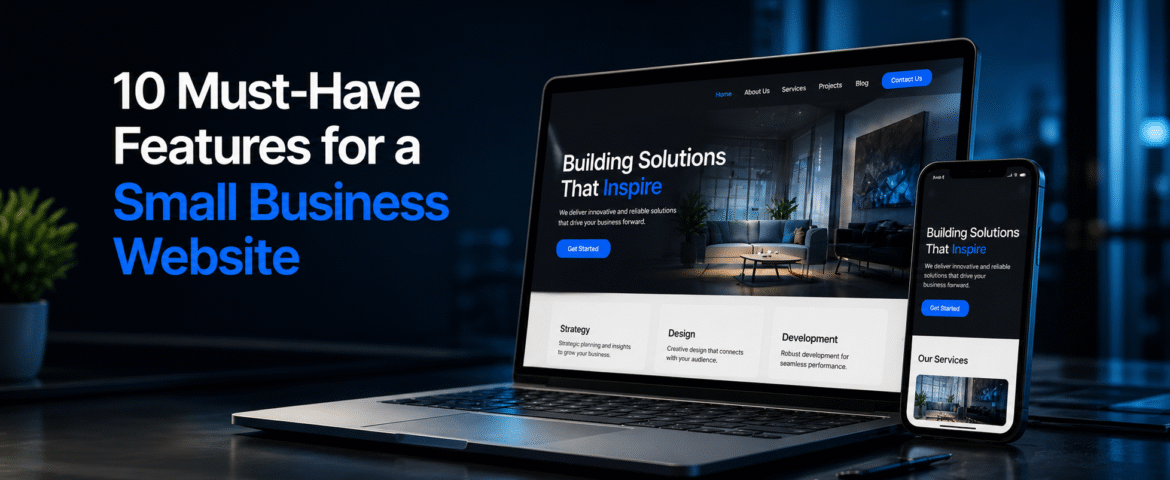
A small business website is more than an online brochure. It is one of the most important marketing tools your business can have.
For many customers, your website is the first impression of your brand. Before they call, book, visit, or buy, they often check your website to understand who you are, what you offer, and whether they can trust you.
Because of that, your website needs more than a clean design. It should be fast, mobile-friendly, secure, easy to use, SEO-optimized, and built to turn visitors into leads.
At Dort Studio, we create marketing websites that help small businesses build trust, attract customers, and grow online. In this guide, we will cover the 10 must-have features every small business website needs.
Why Small Business Website Features Matter
Your website can either help your business grow or quietly push customers away.
For example, if your website loads slowly, visitors may leave before reading about your services. Similarly, if your contact information is hard to find, potential customers may choose a competitor instead.
On the other hand, a well-planned website can build trust, answer customer questions, improve local SEO, and bring in more enquiries.
The right business website features help you create a professional first impression, explain your services clearly, and guide visitors toward action. As a result, your website becomes a useful marketing tool instead of just a digital placeholder.
1. Mobile-Friendly Responsive Design
Mobile-friendly design is one of the most important features every small business website needs.
Today, people visit websites from phones, tablets, laptops, and desktop computers. Therefore, your website should adjust smoothly to every screen size.
Responsive design keeps your content readable, your images properly sized, and your buttons easy to tap. In addition, it helps mobile visitors browse your website without frustration.
A mobile-friendly small business website should include readable text, simple mobile navigation, responsive images, easy-to-use forms, and clear buttons.
Without responsive design, you may lose customers before they even understand what your business offers. However, with a mobile-friendly website, visitors can explore your business from any device.
2. Fast Loading Speed
Website speed plays a major role in user experience. When a page takes too long to load, visitors often leave.
For small businesses, fast loading speed is especially important. Many visitors are looking for quick information, such as services, prices, contact details, or business hours. If your website is slow, they may not wait.
To improve website speed, you should optimize images, use reliable hosting, reduce unnecessary plugins, clean up your code, and maintain your website regularly.
In addition, faster load times can make your business look more professional. A smooth website experience gives visitors more confidence in your brand.
3. Clear and Simple Navigation
Clear navigation helps visitors find what they need quickly.
When someone lands on your website, they should understand where to go next. For example, they should be able to find your services, contact page, about page, and project examples without confusion.
A simple navigation menu may include Home, About, Services, Projects, Blog, and Contact.
Visitors who want to learn more about your company can visit your About Us page. Meanwhile, people who want to explore your offers can go directly to your Services page.
Good navigation improves user experience. More importantly, it helps visitors move through your website with less effort.
4. Strong Calls to Action
A call to action, also known as a CTA, tells visitors what to do next.
Without clear CTAs, people may read your website and leave without contacting you. However, a strong CTA gives them direction.
Examples of effective CTA buttons include Get a Free Quote, Book a Consultation, Contact Us Today, View Our Services, Start Your Project, and Call Now.
Your CTA buttons should appear on important pages such as your homepage, service pages, blog posts, and contact section. In addition, they should be clear, visible, and easy to understand.
For instance, after explaining your services, you can guide visitors to your Contact page. After showing your work, you can invite them to view Our Projects.
A strong CTA makes the next step simple.
5. Easy-to-Find Contact Information
Your contact information should be easy to find.
If a visitor is ready to reach out, they should not have to search through your entire website. Instead, your phone number, email address, contact form, and business details should be visible.
A small business website should include a contact form, email address, phone number, business location, opening hours, and clickable phone number for mobile users.
For local businesses, this is even more important. Customers may want to call, request a quote, ask a question, or visit your location.
Therefore, your website should include a dedicated contact page. It is also helpful to place contact details in the footer and on key service pages.
The easier it is to contact you, the more likely visitors are to become leads.
6. Trust Signals and Customer Testimonials
People want proof before they choose a business.
That is why trust signals are so important. They show visitors that your business is real, reliable, and experienced.
Trust signals can include customer testimonials, reviews, case studies, certifications, client logos, project examples, awards, and years of experience.
For service-based businesses, a portfolio is especially useful. It allows potential customers to see your work before they contact you.
At Dort Studio, the Our Projects page helps visitors explore real examples of completed work. As a result, they can better understand the quality, style, and value of the services.
Trust signals reduce hesitation and help visitors feel more confident.
7. SEO-Optimized Website Structure
A beautiful website is not enough if people cannot find it.
SEO optimization helps your small business website appear in search results when potential customers look for your services. Therefore, your website should be built with both users and search engines in mind.
An SEO-friendly website should include clear headings, optimized title tags, meta descriptions, SEO-friendly URLs, image alt text, internal links, and helpful content.
In addition, small businesses should create detailed service pages instead of placing everything on one page. For example, a business may need separate pages for website design, WordPress development, UI/UX design, digital marketing, or app development.
Internal linking is also important. For instance, this blog links to Dort Studio’s homepage, About Us, Services, Our Projects, and Contact pages.
This helps visitors explore your website and helps search engines understand your site structure.
8. Secure Website with HTTPS
Website security is essential for every small business website.
Visitors want to feel safe when they browse your website, fill out a form, or share personal information. Because of this, your website should use HTTPS and have an SSL certificate.
A secure website should also include reliable hosting, regular backups, updated software, spam protection, strong passwords, and malware monitoring.
Without HTTPS, browsers may show a warning to visitors. As a result, people may lose trust before they even read your content.
Security is not only important for online stores. Even a basic business website with a contact form should protect user information.
A secure website shows professionalism and builds confidence.
9. High-Quality Content That Answers Customer Questions
Your website content should clearly explain what your business does and why someone should choose you.
Many small business websites use vague content. For example, they may say they offer “quality service” without explaining what makes their service valuable.
Instead, your content should answer important customer questions. What do you offer? Who do you help? What problems do you solve? Why should people trust you? How can someone get started?
Helpful website content may include service descriptions, FAQs, blog posts, case studies, pricing details, process explanations, and local business information.
In addition, your homepage should have a clear headline and strong value proposition. Your service pages should explain benefits, not just features.
Good content builds trust before a visitor contacts you. It also supports SEO by answering the questions your customers are already searching for.
10. Analytics and Conversion Tracking
A small business website should not rely on guesswork.
Analytics and conversion tracking help you understand how visitors use your website. For example, you can see which pages get the most traffic, which services attract interest, and how many people submit contact forms.
Useful tracking tools include Google Analytics 4, Google Search Console, Google Tag Manager, Meta Pixel, phone call tracking, and contact form tracking.
With this data, you can improve your website over time. Instead of guessing what works, you can make better decisions based on real visitor behavior.
As a result, your website becomes easier to optimize for leads, enquiries, and business growth.
Bonus Feature: Website Accessibility
Accessibility makes your website easier for more people to use.
An accessible website includes readable fonts, clear color contrast, image alt text, keyboard-friendly navigation, simple layouts, descriptive button text, and clear form labels.
In addition, accessibility improves the overall user experience. When your website is easier to read and navigate, everyone benefits.
Accessibility should be considered during the design and development process. It should not be treated as an afterthought.
Small Business Website Checklist
Here is a simple checklist of must-have website features for small businesses:
- Mobile-friendly responsive design
- Fast loading speed
- Clear and simple navigation
- Strong calls to action
- Easy-to-find contact information
- Customer testimonials and trust signals
- SEO-optimized website structure
- HTTPS and website security
- Helpful, high-quality content
- Analytics and conversion tracking
- Accessibility improvements
If your website is missing several of these features, it may not be performing as well as it could.
How These Features Help Convert Visitors
A successful small business website is built around the customer journey.
First, visitors need to find your website. Then, they need to understand your services. After that, they need to trust your business. Finally, they need a clear way to contact you.
Each feature supports that journey. Responsive design improves mobile browsing. Fast loading speed keeps visitors engaged. Clear navigation helps people find the right page. Strong CTAs guide them toward action. Trust signals build confidence. SEO brings in more traffic. Security protects user trust. Analytics helps you improve results.
Together, these features turn your website into a real marketing asset.
Why Work with Dort Studio?
Building a small business website can feel overwhelming. You need to think about design, content, SEO, speed, security, user experience, and conversions.
That is where Dort Studio can help.
Dort Studio creates affordable web solutions for small businesses, startups, and entrepreneurs. The team focuses on professional website design, responsive development, UI/UX design, WordPress development, Laravel development, app development, and digital marketing support.
You can learn more about the team on the About Us page, explore available solutions on the Services page, or view completed work on the Our Projects page.
Whether you need a new website or want to improve an existing one, Dort Studio can help you create a website that looks professional, works smoothly, and supports business growth.
Conclusion
A small business website should do more than exist online. It should help people find your business, understand your services, trust your brand, and take action.
The 10 must-have features every small business website needs include responsive design, fast loading speed, clear navigation, strong CTAs, contact information, trust signals, SEO optimization, security, helpful content, and analytics tracking.
When these features work together, your website becomes a powerful marketing tool.
If your current website feels outdated, slow, confusing, or does not generate enough leads, it may be time for an upgrade.
Ready to improve your website? Contact Dort Studio today and start building a stronger online presence for your business.
FAQ
What features should a small business website have?
A small business website should include responsive design, fast loading speed, clear navigation, strong calls to action, contact forms, SEO optimization, customer testimonials, website security, helpful content, and analytics tracking.
Why is mobile-friendly design important for small business websites?
Mobile-friendly design is important because many visitors use smartphones to browse websites. A responsive website makes sure your content, buttons, images, and forms work properly on every screen size.
How can a small business website generate more leads?
A small business website can generate more leads by using clear CTAs, contact forms, trust signals, service pages, local SEO, helpful content, and conversion tracking.
Does every small business website need SEO?
Yes. SEO helps potential customers find your business online. Without SEO, your website may struggle to attract traffic from search engines.
Why is website speed important?
Website speed is important because slow pages can cause visitors to leave. A fast website improves user experience and helps people browse your services more easily.
What is the most important page on a small business website?
The homepage is usually the most important page because it creates the first impression. However, service pages, project pages, and contact pages are also important for building trust and generating leads.
How often should a small business update its website?
A small business should update its website whenever services, prices, contact details, projects, testimonials, or business information changes. Regular updates also help keep the website fresh, accurate, and useful for visitors.
Leave A Comment